Tax benefits and calls for tenders
INAIL PREVENTION AND SAFETY
The ISI INAIL 2024/2025 call for tenders offers Italian companies a non-repayable grant of 65% (up to EUR 130,000) for projects that improve the health and safety of workers, including interventions on technopathic, accident and asbestos risks, and for small companies in specific sectors.
INAIL has published the OT24 model for 2025, allowing companies to obtain a reduction in their insurance premium through a discount on the average tariff rate, provided they have undertaken additional occupational safety measures. The relief is available to companies that have been active for at least two years.
INDUSTRY 5.0 AND TRANSITION 5.0
Industry 5.0 integrates digital technologies and human skills in a strategic synergy, where both have complementary roles. The aim is to improve efficiency, innovation and work well-being by enhancing human skills in the production process.
In Italy, the Ministry of Enterprise and Made in Italy launched the Transition 5.0 Plan, complementary to Industry 4.0, with a fund of EUR 6.3 billion for the two-year period 2024-2025. The plan is made operational by the implementing decree published in the Gazzetta Ufficiale No. 183.
NEW SABATINI CAPITALISATION
Our systems are among the capital goods that can be financed under the Nuova Sabatini and can benefit micro, small and medium-sized enterprises.
INDUSTRY 4.0
Our systems are fully compliant with the requirements of Industry 4.0 incentives.
WHAT CAN WE DO FOR YOU?
ICOY CAN HELP YOU IN THIS TECHNOLOGICAL TRANSITION
BUILDING A SAFER FUTURE TOGETHER.
INAIL Prevention and Safety
ISI INAIL 2024/2025 call for tenders
The ISI INAIL 2024/2025 is aimed at all Italian companies, including sole traders, located in any region and registered with the Chamber of Commerce. The ISI INAIL offers a non-repayable contribution of 65% of eligible expenditure, up to a maximum of €130,000 for investment projects that aim to improve the health and safety of workers through various types of projects, including:
- projects for the reduction of technopathic risk
- projects for the adoption of organisational and social responsibility models
- projects for accident risk reduction
- projects for the remediation of materials containing asbestos
- projects for micro and small enterprises operating in specific sectors of activity
- projects for micro and small enterprises operating in the primary production of agricultural products
Although the Call Bando Inail changes slightly each year compared to previous years, generally this instrument finances investment projects for the reduction of certain risk factors present in the company, such as:
- plant renovation or modification
- installation and/or replacement of dated machines, devices and/or equipment with new models
- changes to the production layout
- interventions related to the reduction/elimination of risk factors such as exposure to biological agents, chemicals, carcinogens and hazardous substances
- projects for the adoption of organisational and social responsibility models
- projects for load handling risk reduction
- projects for the remediation of materials containing asbestos
- projects for micro and small enterprises operating in specific sectors of activity
- projects for micro and small enterprises operating in the primary production of agricultural products.
What are the eligible expenses in the Call Bando ISI INAIL 2024/2025?
Eligible expenses include those for the reduction of various types of occupational risks, such as chemical risks, noise, vibrations, manual handling of loads, falls from height, and working in confined spaces. Also eligible are expenses for the adoption of organisational and social responsibility models, asbestos abatement, and the replacement of obsolete machinery. The expenses considered eligible by the call are:
- expenditure directly necessary for the implementation of the project
- incidental or instrumental expenses functional to the implementation of the project and indispensable for its completeness
- any technical expenses (within certain regulatory limits)
All eligible expenses must relate to projects that had not been implemented and were not in progress at the closing date of the online application form, and the following types of expenses are not eligible:
- Acquisitions through leasing
- Purchase of second-hand goods
The non-refundable grant.
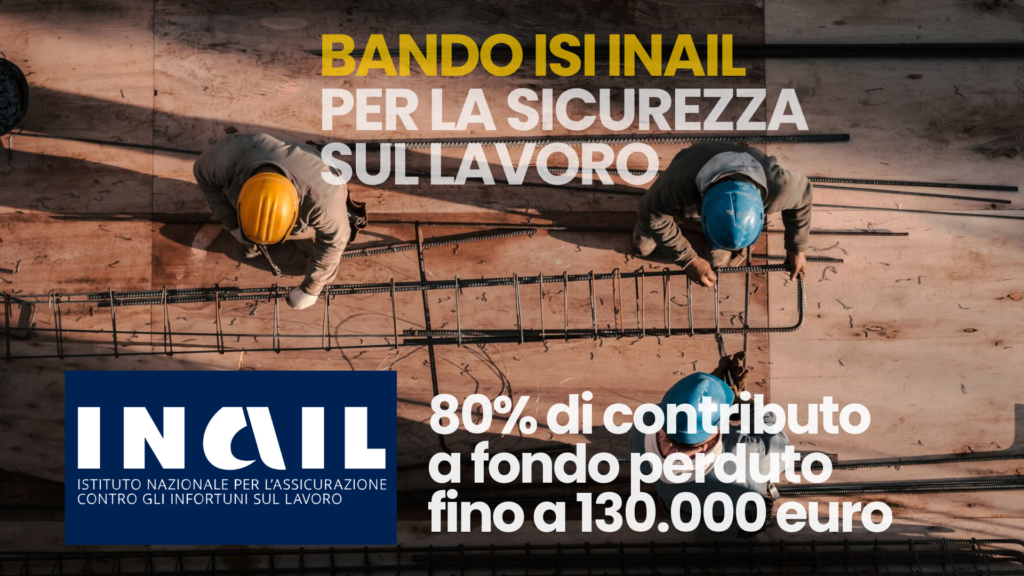
The Bando Inail aimed at facilitating investment projects to improve health and safety conditions for workers, allows companies to obtain a non-repayable contribution of 65% up to a maximum of €130,000 for new company investments to improve health and safety in the workplace.
OT23 > OT24 Model

What is the OT24 model?
INAIL has published the OT24 model for 2025 that companies must use in order to have their average rate reduced as a result of the implementation of additional measures, compared to their legal obligations, on safety at work.
Model OT24: What is oscillation for prevention
The Ministerial Decree of 12 December 2000, amended by the Ministerial Decree of 3 March 2015, offers companies the possibility of reducing the annual insurance premium due to INAIL. This reduction takes place through the application of a discount called ‘fluctuation for prevention’ on the average tariff rate.
The relief is granted to companies that have been in business for at least two years and can demonstrate that they have taken additional action to improve health and safety.
How is the INAIL OT24 rate reduction calculated?
To calculate the reduction in the INAIL rate via the OT24 form, it is necessary to take into account the number of workers in the company. For companies with less than two years of activity, the reduction is set at 8%.
ACCESS TO THE AVERAGE RATE REDUCTION FOR PREVENTION (OT24) FOR THE YEAR 2025
Industry 5.0
Industry 5.0 marks a revolutionary breakthrough in manufacturing, integrating digital technologies and human skills. It is not just a collaboration between man and machine, but a true strategic synergy in which both have complementary roles. The aim is to enhance human skills, putting them at the heart of the production process to improve efficiency, innovation and working well-being.
Industry 5.0: definition
The term Industry 5.0, adopted by the European Commission, originated as a complementary concept to Industry 4.0. This new approach encourages industrial development towards a production model centred not only on technological innovation and economic growth, but also on a commitment to environmentally responsible practices. It also encourages the consolidation of resilience strategies that strengthen the industry in the face of disruptions, such as the one resulting from the Coronavirus pandemic.
Industry 5.0: features
The growth and development model promoted by Industry 5.0 is based on three fundamental pillars:
- Sustainability: developing production systems based on renewable energy is one of the requirements promoting Industry 5.0
- Human approach: Industry 5.0 places humans at the centre of the production model. The premise is clear, instead of asking what we can do with new technology, let us ask what technology can do for us. This more social and human aspect also ensures that the use of technology does not violate workers’ fundamental rights, such as the right to privacy, autonomy and human dignity
- Resilience: resilience has become a key aspect in fighting the COVID-19 pandemic. Consequently, having the ability to adapt to adverse situations with positive results is an obligation in the new Industry 5.0.
With a sustainable, human-centric and resilient approach, Industry 5.0 aims to successfully tackle disruptions and challenges using technology.
The differences between Industry 4.0 and Industry 5.0
Industry 5.0 is not an evolution of Industry 4.0. According to the European Commission, the fourth industrial revolution has focused mainly on the digitisation of processes and the use of artificial intelligence to increase productivity and efficiency, putting aside, among its priorities, the role of workers in the production fabric or the transition to more sustainable development models.
In Industry 5.0, the human factor returns to centre stage as a fundamental element of the production process. According to this premise, technology must be put at the service of man and not the other way around, so the aspiration is to move towards a scenario of complete collaboration between man and machine. In summary, if Industry 4.0 is based on the interconnectivity between machines and information systems, Industry 5.0 seeks to combine the roles of people and machines so that they can strengthen and complement each other.
Technology for moving towards Industry 5.0
Technology to move towards Industry 5.0
According to the European Commission and within the technology framework, there are six essential categories to stimulate Industry 5.0:
- Individualised human-machine interaction
- Bio-inspired technologies and intelligent materials
- Digital twins and simulation
- Transmission, storage and analysis technologies
- Artificial intelligence (AI)
- Technologies for energy efficiency, use of renewable technologies, storage and autonomy.
Transition 5.0?
In line with the European Commission’s Industry 5.0 vision, in Italy the Ministry of Enterprise and Made in Italy has established the Piano Transizione 5.0 complementary to Industry 4.0 with a total fund of EUR 6.3 billion available for the two-year period 2024-2025, made operational through the implementing decree published in the Gazzetta Ufficiale No. 183.
New Sabatini Capitalisation
How the New Sabatini capitalisation works
The ‘New Sabatini Capitalisation’ measure is the facility made available by the Ministry of Enterprise and Made in Italy with the aim of facilitating companies’ access to credit and increasing the competitiveness of the country’s production system.
Which assets are covered by the New Sabatini
The facility supports investments to purchase or lease machinery, equipment, plant, capital goods for productive use and hardware, as well as software and digital technologies.
The capital goods measure (‘New Sabatini Capitalisation’) aims to encourage the capitalisation of SMEs that intend to carry out an investment programme in machinery, equipment, plant, capital goods for productive use and hardware, as well as software and digital technologies
Who is eligible?
Eligible applicants are micro, small and medium-sized enterprises (SMEs) that at the date of application:
- they are duly constituted and registered in the Commercial Register or Fishing Business Register
- they are in the full and free exercise of their rights, are not in voluntary liquidation or subject to bankruptcy proceedings with the aim of liquidation
- they are not among the entities that have received and, subsequently, not reimbursed or deposited in a blocked account, aid considered illegal or incompatible by the European Commission
- they are not in a situation to be classified as companies in difficulty
have their registered office or a local unit in Italy. For companies not resident in Italy, possession of a local unit in Italy must be demonstrated when submitting the application for the grant.
Come viene erogato il contributo della nuova Sabatini?
For access to incentives the companies must have approved a share capital increase of no less than 30% of the amount of the requested financing. The subsidy is granted as a plant account and its amount is determined as the value of the interest calculated, by agreement, on a loan with a duration of five years and an amount equal to the investment, at an annual interest rate equal to:
- 5% for micro and small enterprises
- 3.575% for medium-sized enterprises.
Regarding the presentation of request companies must fill in and send the appropriate form available on the website of the Ministry of Enterprise and Made in Italy, following the instructions provided in Circular No. 410823 of 6 December 2022.
Industry 4.0
Tax credit for research and development, technological innovation, design and aesthetic conception
During the current legislature, a series of measures attributable to the so-called ‘Transition 4.0 Plan’, formerly ‘Industry 4.0 Plan’, have been refinanced. The tax legislature has strengthened and modified facilitative measures to encourage investment and technological innovation such as the so-called patent box and the tax credit oriented towards the 4.0 transformation of enterprises.
WHAT CAN WE DO FOR YOU?
ICOY CAN HELP YOU IN THIS TECHNOLOGICAL TRANSITION
BUILDING A SAFER FUTURE TOGETHER.