Awards, Patents and Certifications
Awards, Patents and Certifications
The domain of Artificial Intelligence and its applications is constantly evolving and the frontier facing companies, researchers and institutions is mobile and constantly projected forward. At the corporate level, the question arises as to which models to use and which are the best criteria for selecting them. It is essential to rely on companies that have patented and/or certified the artificial intelligence-based systems they propose on the market and have already successfully applied them in important realities on the Italian scene. Icoy boasts the following patents and certifications: Italian Project Awards, Icoy Brevetto Italiano, Bureau Veritas and iso, Confindustria Romagna, Icoy Mover Forklift and Icoy Guardian.


BUREAU VERITAS E ISO

ISO 9001 e 45001


Person Detection Device / Collision Avoidance System (CAS)
How does the AI Artificial Intelligence ICOY work?
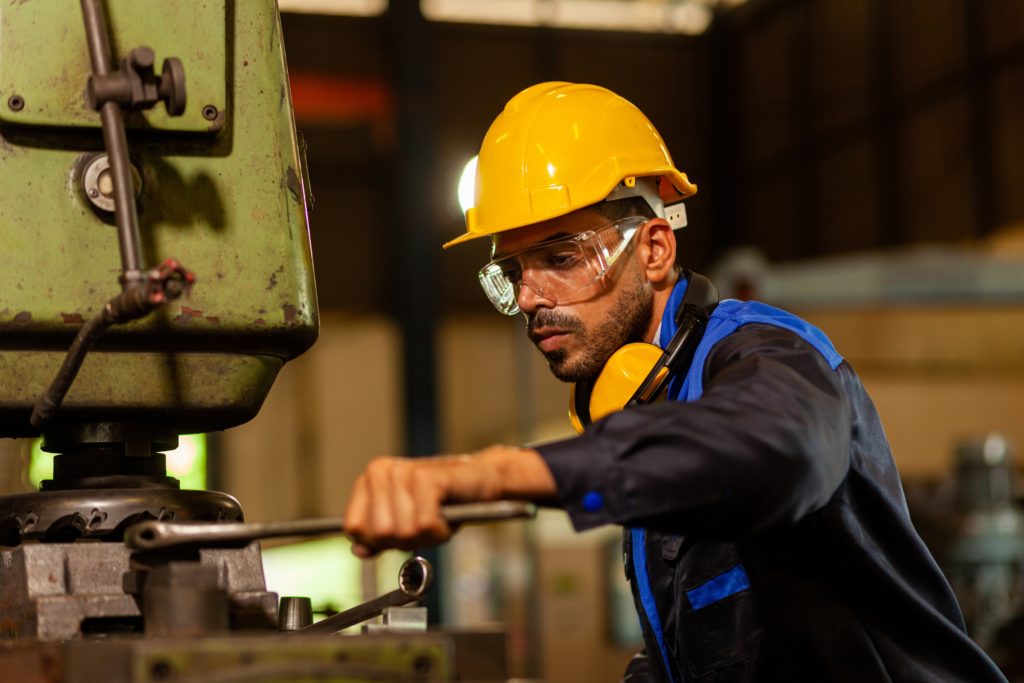
Our ICOY (I care of You) systems are Artificial Intelligence-based solutions with the aim of helping humans (not replacing them) to make workplaces safer.
The ICOY intelligent agents created by Itway S.p.A are placed on overhead cranes, forklifts, large stackers and/or in critical and particularly ‘unsafe’ areas inside construction sites, tunnels, industries, ports where visibility is poor, where the atmosphere is laden with fine dust, smog or fog. The sole objective is to help workers, operators, and labourers control these areas and means of transport, thus making work procedures safer.
ICOY systems are an enhancement of our sense of sight that we can use while working, and thanks to monitors, alarm sounds and luminous perimeters traced on the ground, they help us live more safely.
Why choose patented and certified AI-based systems?
Regulating and managing AI is a difficult but necessary challenge.
It is important to find that balance point that promotes innovation and protects people’s rights and welfare. Laws and regulations must be flexible enough to adapt to rapid technological change, but also robust enough to ensure that AI is used in a safe and socially sustainable way. Artificial intelligence challenges traditional assessment methods and raises complex questions about regulation. As innovation accelerates, it is crucial to find a balance that promotes safety and social welfare without stifling progress.

The advantages ofAI Artificial Inteligence.
While performing work activities, our attention is focused on the execution of tasks, developing over time behaviours and strategies aimed at achieving goals. The brain, by nature, tends to optimise processes by turning them into routines, thus reducing the cognitive effort required. This neurobiological mechanism, fundamental for survival, saves energy and minimises risks.
However, even in the working environment, the tendency to repeat actions in an automated manner can limit the ability to detect and prevent risk situations. Despite experience, distractions and accidents can occur. For this reason, ICOY stands as a strategic support, enhancing the ability to monitor, control and ensure safety in daily activities, contributing to a more efficient and protected working environment.
Relying on an independent third party to verify compliance with pre-established standards demonstrates Itway S.p.A.’s commitment to ensuring the appropriate, safe and responsible application of these technologies.
The first step was to patent our technology ICOY Mover Crane ® Italian Patent No. 102020000016051. A patent is a protection granted to inventions that represent a new, original and innovative solution. To be patentable, an invention must meet certain requirements: it must be new, possess inventive step and have industrial applicability.
An invention is considered new if it is not included in the state of the art at the time the application is filed. For there to be inventive step, the invention must not be obvious or obvious to an expert in the relevant field at the time the application is filed.
To comply with the third requirement, that of industrial applicability, the invention must be capable of industrial application, i.e. it must be able to be used in any sector of industry, including agriculture.
Whoever chooses ICOY has a first major certainty, namely, that it is a patented system, unique in Italy, with Itway Group S.p.A. behind it, 30 years of experience in cyber security, data management, data science and industrial relations.
WE ARE ON YOUR SIDE TO MAKE WORKPLACES SAFER THROUGH PATENTED, CERTIFIED AND AWARDED TECHNOLOGIES.
ASK FOR ADVICE
BUILDING A SAFER FUTURE TOGETHER.
Certification
Having certified ICOY systems with CE Examination, according to the Machinery Directive 2006/42/EC – Allegato IX, proves that our ICOY solutions are verified according to the procedure and comply with the essential health and safety requirements defined in the Directive.
The Machinery Directive 2006/42/EC, or MD (Machinery Directive), is a set of rules aimed at manufacturers of machinery and partly completed machinery marketed and used within the European Union. With this directive, the EU sets out the Essential Safety Requirements (RES) in order to:
- enable the free movement of machinery within the european market
- safeguard the safety and protect the health of users.
Which products are affected by EU Directive 42/2006?
In the text of the direttiva 2006/42/CE products covered by the regulation are specified and defined:
- the machines
- quasi-machines
- interchangeable equipment
- safety components
- lifting accessories
- chains, ropes and belts
- removable mechanical transmission devices.
What is the Performance Level (PL)?
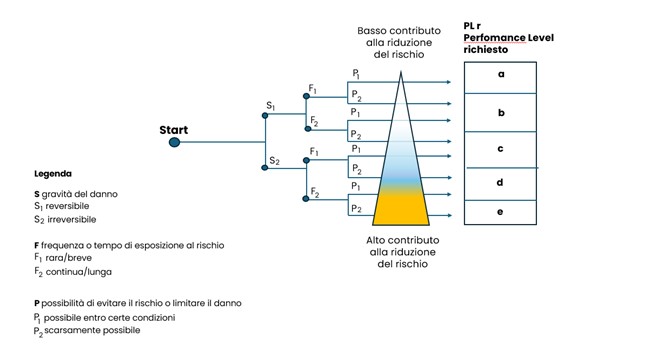
Performance Level (PL) is a key concept in the evaluation of the functional safety of machine control systems. Defined by EN ISO 13849-1, the PL measures the reliability and ability of a safety system to prevent or mitigate risks associated with machine operation.
It is one of the fundamental requirements to ensure that machines operate safely, as required by the Machinery Directive.
Each level represents a different degree of risk reduction:
- PL a: minimal risk reduction, only acceptable for functions with a low level of risk
- PL b: moderate risk reduction
- PL c: intermediate level of risk reduction
- PL d: high level of risk reduction
- PL e: maximum risk reduction, required for critical functions.
Performance Level Calculation Steps
The process of calculating the Performance Level for a safety system consists of several steps:
1. Identification of the Security Function
Risk analysis: The first step involves identifying the security functions required to mitigate the risks identified during the initial risk assessment.
Function definition: Each safety function must be clearly defined in terms of the actions to be taken to prevent or mitigate a specific risk.
2. Determination of PL Requirements
– Risk Parameters: The determination of the PL required for each safety function is based on three basic parameters:
– S (Severity): Severity of injury that could result from a safety system failure.
– F (Frequency): Frequency or exposure to the hazard.
– P (Possibility): Possibility of avoiding the hazard or reducing the harm.
– Using these parameters, the required performance level for the safety function is determined, according to the tables in EN ISO 13849-1.
3. Evaluation of the Control System
· System architecture: The configuration of the control system, which may include redundancy, fault detection and other features, is evaluated to determine the PL that the system can actually achieve.
· Reliability of components: Individual components of the control system are evaluated in terms of reliability and durability. Components with high reliability contribute to a higher PL.
4. PL calculation
· MTTFd (Mean Time to Dangerous Failure): This is one of the key parameters in the PL calculation, representing the mean time to dangerous failure. A higher MTTFd contributes to a higher PL.
· DC (Diagnostic Coverage): Percentage of failures detected and handled by the safety system. A high DC improves the PL.
· CCF (Common Cause Failure): Assessment of the risk of failures due to common causes, which may reduce the effectiveness of redundancy in the system.
5. Validation and Verification
· Verification of the achieved PL: Once calculated, the PL must be verified and validated against the required PL. This process includes simulations, functional tests and Failure Modes and Effects Analysis (FMEA) to ensure that the safety system operates as intended.
Importance of PL Calculation in the Machinery Directive
- Functional Safety: PL calculation is essential to ensure that machine control systems can prevent dangerous failures and reduce risks to operators. A system that does not achieve the required PL may not be sufficiently reliable, exposing users to unacceptable risks.
- Regulatory Compliance: The Machinery Directive 2006/42/EC requires machines to be designed and constructed in a safe manner. PL calculation and verification are essential to demonstrate that safety systems meet the requirements of the directive and related harmonised standards, such as EN ISO 13849-1.
- Legal Protection: Proper documentation and validation of the PL protects manufacturers from legal liability in the event of a failure or accident by demonstrating that all necessary safety measures have been taken and verified.
Performance Level (PL) calculation is an essential part of the design and verification process of machine control systems according to the Direttiva Macchine 2006/42/CE .
Accurate analysis and proper implementation of PL ensure not only the safety of operators, but also regulatory compliance and legal protection for manufacturers.
What does it mean to have achieved the highest performance level?
The ICOY Guardian and ICOY MOVER Forkflit systems received the highest PL e rating, meaning that they are highly reliable systems with a high capacity to prevent or mitigate risks associated with machine operation.
AI ACT

From 1 February 2025, the measures are in force of AI Act, the European Union’s Artificial Intelligence (AI) regulation, which prohibits the use of AI when it exposes people to ‘unacceptable risks’. Among these risks, the EU Commission includes all ‘clear threats to people’s security, livelihoods or rights’.We have chosen to rely on an independent third party to verify compliance with pre-established standards, in order to testify to Itway S.p.A’s commitment to the appropriate, safe and responsible application of these technologies.
Artificial intelligence is a great challenge that will always propel us forward, but through a structured management of AI and an orientation towards continuous improvement, we at Itway S.p.A want to generate confidence in our activities, reducing accidents at work, and increasing worker safety.
WE ARE ON YOUR SIDE TO MAKE WORKPLACES SAFER THROUGH PATENTED, CERTIFIED AND AWARDED TECHNOLOGIES.
ASK FOR ADVICE
BUILDING A SAFER FUTURE TOGETHER.